Microsoft 365 Tenant Discovery Tool
Microsoft 365 Tenant Discovery Tool
Couldn't load pickup availability
Planning a Microsoft 365 migration or tenant assessment? Stop clicking through a dozen admin centres.
The Microsoft 365 Tenant Discovery Tool collects everything you need to scope, batch and plan the work and puts it into one Excel workbook, with a summary page that gives you the size of the tenant at a glance.
It's a menu-driven PowerShell tool that runs on your own machine and connects to the tenant with its own certificate-secured app registration, which it creates for you. It's read-only: it never changes anything in the tenant. The standard run needs no sign-in prompts, so you can start it and leave it running.
What it reports on
Every area below is a separate, filterable sheet in the workbook, with a Summary page that adds up the key totals.
Users and identities
- User Accounts - every licensed user with a mailbox: display name, UPN, primary email, alias, onmicrosoft address, department, job title, office, mailbox size and item count, deleted items size and count, archive size and item count, OneDrive size, file count, URL and last activity, licences assigned (and whether directly or through a group), disabled service plans, admin roles held, usage location and whether the account is synced from on-premises
- Identities - accounts with no mailbox, such as service accounts and admin-only accounts, kept separate so they don't inflate your mailbox counts
- Guest Accounts - every external user, with their email addresses and any licences
- Account Activity - last sign-in (interactive, non-interactive and successful) and days since, with each account flagged Active, Inactive (90+ days, adjustable) or Never signed in. Shows whether each account is licensed and enabled, so disabled accounts still holding a licence stand out
- Directory Sync - whether directory sync is on, last sync and last password hash sync (with a warning if sync is stale), counts of synced, cloud-only and previously synced accounts, and any federated domains
- Password Details - last password change, password age, policy, expiry date and days until expiry, using each domain's own password policy
- MFA Details - per user: whether MFA is registered and which methods are set up (Authenticator app, phone, FIDO2 key, Windows Hello, email, software OATH token or Temporary Access Pass)
Exchange Online
- Shared Mailboxes and Resource Accounts (room and equipment) - sizes, item counts, archives, email addresses and licences
- Mailbox Permissions - Full Access and Send As permissions on every mailbox, showing who has access to what
- Mailbox Holds - litigation hold (date and duration), Microsoft 365 retention policy holds, eDiscovery case holds, retention hold, delay holds, compliance tag holds, retention policy, archive status and auto-expanding archive, with a migration note on every mailbox under a hold
- Org-Wide Holds - retention policies that apply to every mailbox, including new ones
- Email Forwarding - mailbox-level forwarding (internal and external SMTP), plus inbox rules that forward, redirect or send to another address
- Distribution Lists and members - owners, join and leave restrictions, moderation, delivery restrictions, hidden from address list, directory sync status and all email addresses
- Contacts - every mail contact with company, address and phone details
- Public Folders - folder path, mail-enabled status and address, item count, size and last modified date
- Accepted Domains and MX Records - domain type, default domain and where mail is delivered today
- Receive and Send Connectors - partner and on-premises connectors, IP addresses, sender domains, TLS settings and smart hosts
- Transport Rules - name, state, mode, priority and description
- Anti-Spam, Outbound Spam, Anti-Malware, Safe Attachments and Safe Links - the actions, thresholds, allow and block lists, auto-forwarding mode and notification settings of every policy
- Audit Configuration - unified audit log status, admin audit settings, accounts that bypass mailbox auditing, and whether Purview Audit (Premium) is active
OneDrive and SharePoint
- SharePoint Sites - every site and subsite with storage used (bytes and GB), file count, active files, page views, last activity, owner, site template (with the template code used to recreate it), whether it is connected to a Team, its sensitivity label and its hub site
- SharePoint Doc Libraries - every document library in every site and subsite, with its true size, item count, URL, parent site and the Team it belongs to
- Hub Sites - every hub, its URL, parent hub and how many sites are associated with it
- Sensitivity Labels - every label, its priority, whether it applies protection, what it can be applied to and how many sites use it
- SPO-OD Sharing Config - SharePoint and OneDrive external sharing levels, default link type and permission, guest and link expiry, domain allow and block lists, idle session sign-out and legacy authentication settings
- OneDrive size, file count, URL and last activity for every user (on the User Accounts sheet)
Teams, groups and Planner
- Teams - every Team with its site URL, visibility, number of standard, private and shared channels, total storage, private and shared channel storage (often missed in migrations), incoming shared channels and email addresses
- Teams Membership - owners and members of every Team
- Unified Groups and members - Microsoft 365 groups that are not Teams, with owners, member counts, SharePoint URLs and moderation settings
- Security Groups and members - standard and mail-enabled security groups
- Planners - every plan with the group it belongs to and who created it
Identity security and access
- Conditional Access - every policy with its state, included and excluded users, groups, roles, apps, platforms and locations (shown by name, not ID), client app types, risk levels, grant controls and session controls
- Named Locations - trusted IP ranges and countries
- Entra Role Assignments - who holds every admin role, including service principals and groups, with role descriptions
- Auth Methods Policy - which authentication methods are enabled and who they are targeted at
- External Collaboration - guest invite settings, default user permissions, cross-tenant access defaults and SharePoint guest sharing
- Secure Score - the current and maximum score, plus every control with its score, implementation status, threats covered and remediation advice
Applications
- Enterprise Apps & OAuth - every delegated permission granted to apps (and whether it was granted for everyone or one user), and every application permission held by third-party and in-house apps, shown by permission name
- App Credentials - every client secret and certificate on app registrations and enterprise apps, including SAML signing certificates, with start and end dates, days remaining and an Expired / Expires within 30 days / Expires within 90 days / Valid status. The most urgent are listed first
Devices
- Azure AD Devices - every Entra ID device with join type (joined, registered or hybrid joined), OS and version, owners and users, managed and compliant status, registration date, last sign-in, days inactive, group and administrative unit membership, BitLocker key present and extension attributes
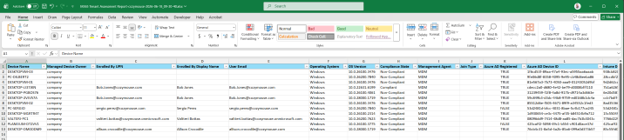
- Intune - Devices - every managed device with enrolled user, OS and version, compliance state, management agent, serial number, IMEI, model, manufacturer, storage, encryption, enrolment and last sync dates, and threat state
- Intune - Compliance Policies and Config Profiles - platform, assignments (with group names) and device success, error, conflict and pending counts
- Intune - Managed Apps - every app with publisher, type and publishing state
Licensing
- License Information - every subscription with a friendly product name, total, consumed and available licences, and status
- Licences per user, including group-based licensing and disabled plans (on the user sheets)
Power Platform (optional menu option)
- PP Environments - type, region, default and Managed Environment status, environment group, Dataverse URL, and how many apps, flows and agents each one holds
- PP Apps - canvas, model-driven, code and App Builder apps with owner and owner status, creator, dates, last published, how many users and groups each app is shared with, and quarantine status
- PP Flows - cloud, agent and Microsoft 365 workflow flows with on/off state, trigger, owner and owner status
- PP Agents - Copilot Studio and Agent Builder agents with owner, published state, channels, authentication, sharing (including "entire tenant"), sessions, distinct users and outcomes, and risk flags (owner disabled or missing, stale, never published, quarantined)
- PP DLP Policies, Tenant Settings and Tenant Isolation - connector governance and tenant-wide guardrails
- PP Owners - every owner checked in Entra ID: Active, Disabled or Not found
Report housekeeping
- Summary - the tenant name, plus totals for mailboxes, archives, OneDrive, Teams and SharePoint storage, groups, MFA, devices by platform, privileged roles, passwords, Secure Score, account activity, app credentials, mailbox holds, labels and hubs, and Power Platform
- Run Log - every section with its status (OK, Error, Not Licensed or Skipped) and the reason
- Report Info - tenant, collection date, tool version and run time
Built for migration planning
Every sheet is filterable, and the key sheets include a Migrate column so the workbook can be used directly as a migration runsheet for batching users, mailboxes, sites and Teams. The summary page totals mailboxes, archives, OneDrive, Teams and SharePoint storage, along with groups, MFA, devices, privileged roles, Secure Score and all of the new V9.10 checks.
What you get
- The Microsoft 365 Discovery Tool (PowerShell launcher and module)
- The Excel summary report template
- The configuration file
- A full step-by-step run guide (Word)
- The changelog
Requirements
- Windows with PowerShell 5.1 or PowerShell 7
- A Global Administrator to register the app once (the tool does this for you and opens the consent page)
- For the optional Power Platform section: a Power Platform Administrator, Global Administrator or Global Reader account to sign in with
- Required PowerShell modules are checked and installed from the menu
New in V9.10 (October 2026)
- Power Platform discovery - environments, Power Apps, Power Automate flows, Copilot Studio and Agent Builder agents (with basic usage), DLP policies and tenant settings. Every owner is checked in Entra ID, so orphaned apps, flows and agents stand out before you migrate.
- App secrets and certificates - every client secret and certificate on app registrations and enterprise apps, including SAML signing certificates, flagged as expired, expiring within 30 days or expiring within 90 days.
- Account activity - last sign-in for every account, inactive and never-signed-in accounts, disabled accounts still holding a licence, and directory sync status for hybrid tenants.
- Mailbox holds - litigation, retention policy, eDiscovery and delay holds per mailbox, plus organization-wide holds, with a migration note on every mailbox that has one.
- SharePoint sensitivity labels and hub sites - the label and hub for every site, and accurate document library sizes.
- New summary tiles for all of the above, with the tenant name shown at the top of the report.
- Run it from any folder - each run gets its own folder with the workbook, a full JSON copy of the data and a CSV per sheet. You can rebuild the workbook later without reconnecting to the tenant.
- Lighter install - only one small Microsoft Graph module is needed instead of the full Graph SDK.
-
More reliable - Microsoft throttling is retried automatically, and if one section can't be read the rest of the report still completes. A Run Log sheet tells you exactly what was skipped and why.
Free updates for life
Buy once and every future update is yours. Updates are sent to all previous buyers, and the full instructions are updated and included with every release.
Already own V8.12? Your V9.10 update is on its way. Delete the old app registration in Entra ID and re-run the registration option, so the new read-only permissions are added.
Share